Web Dev Project

Pallets Service - Rebuilding a Pallet Manufacturer's Website

Client
PALLETS SERVICE, Doruchów (PL)
Type
Redesign and rebuild
Languages
PL · EN · DE
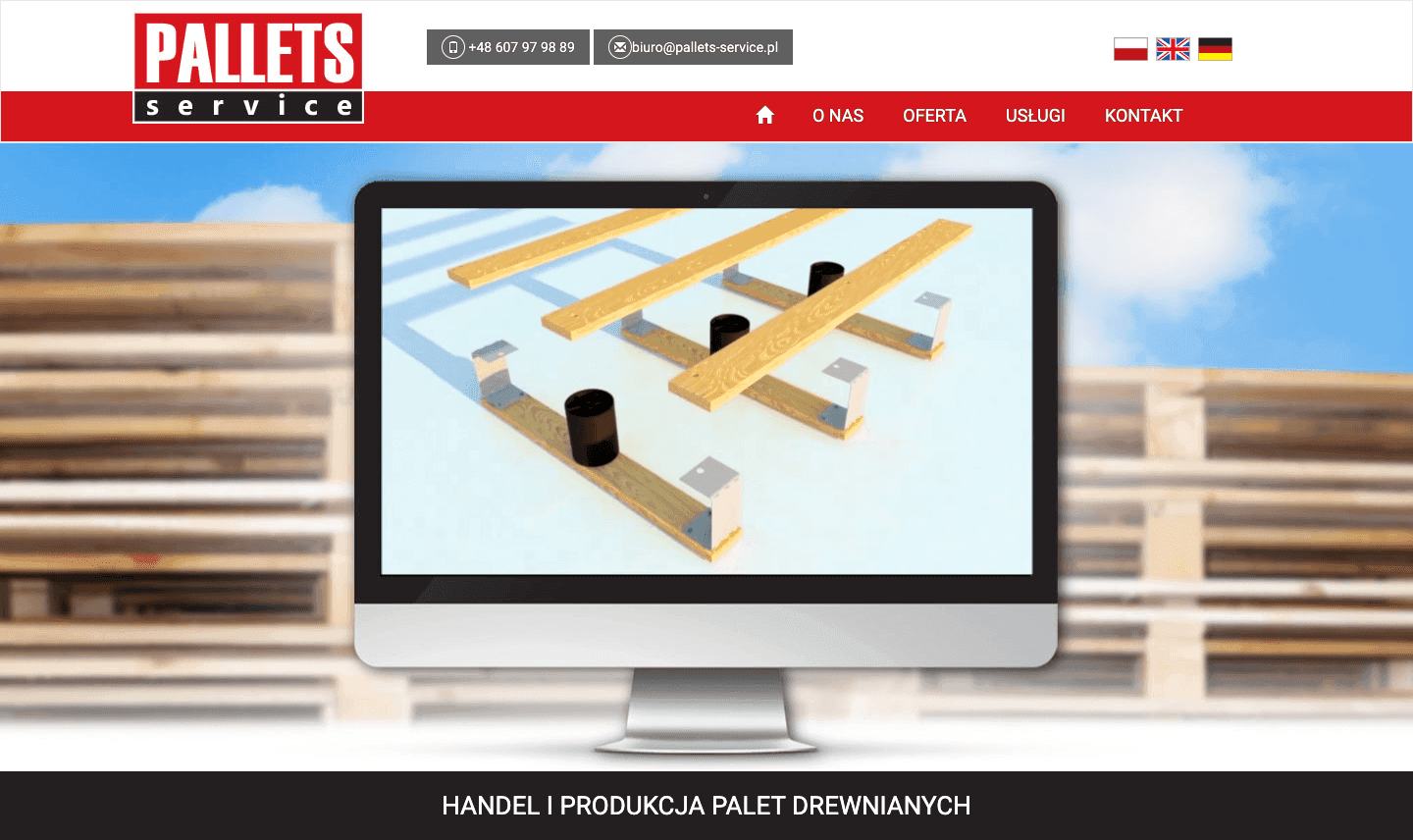
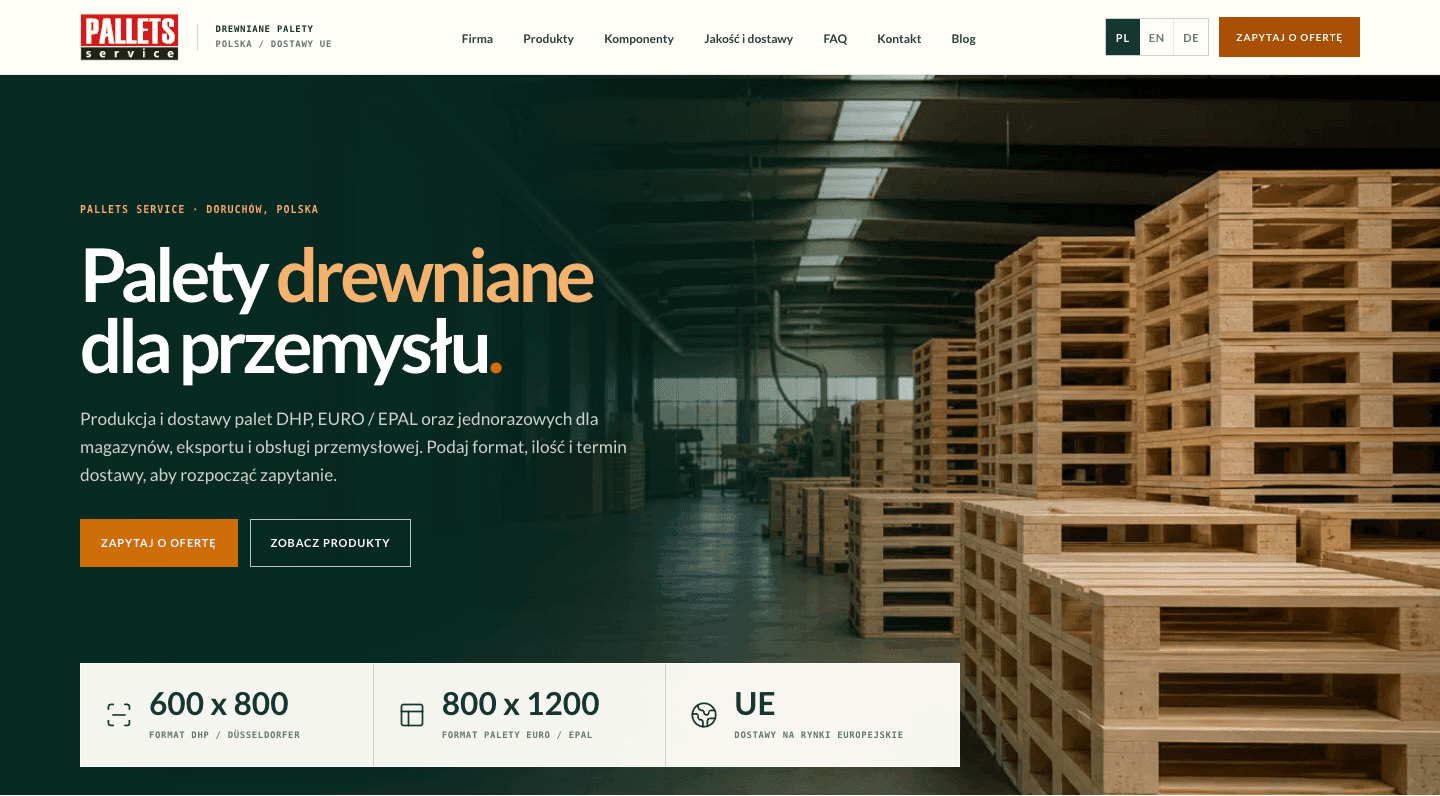
The 2016 PALLETS SERVICE home page on desktop: a red navigation bar, flag icons for the languages and a video of a pallet being assembled, shown inside a computer mockupThe new home page on desktop: a dark green hero with the headline Palety drewniane dla przemysłu, a quote request button and a photo of pallets stacked in a warehouse
Drag the handle to compare, or focus it and use the arrow keys.

Overview

About the project

PALLETS SERVICE is a Polish producer and supplier of wooden pallets from Przytocznica in Wielkopolska. It sells DHP/Düsseldorfer half-pallets, EURO/EPAL pallets, one-way export pallets and DHP components, mainly to customers in the EU.

The company's previous website dated from 2016. It listed the products, but it had no inquiry form and no usable search metadata, and its mobile menu did not work. I rebuilt it as a fast, trilingual site built around one action: requesting a quote.

The new site has a home page with the full offer and an FAQ, a dedicated page for each product family with technical specifications, a contact page with a structured quote form, and a blog with practical articles on pallet formats, export rules (ISPM 15/IPPC) and transport. Everything is available in Polish, English and German, with localized URLs.

It is built with Astro and ships as static HTML. Three interactive parts (the product carousel, the quote form and the FAQ) are React islands that load only when they scroll into view.
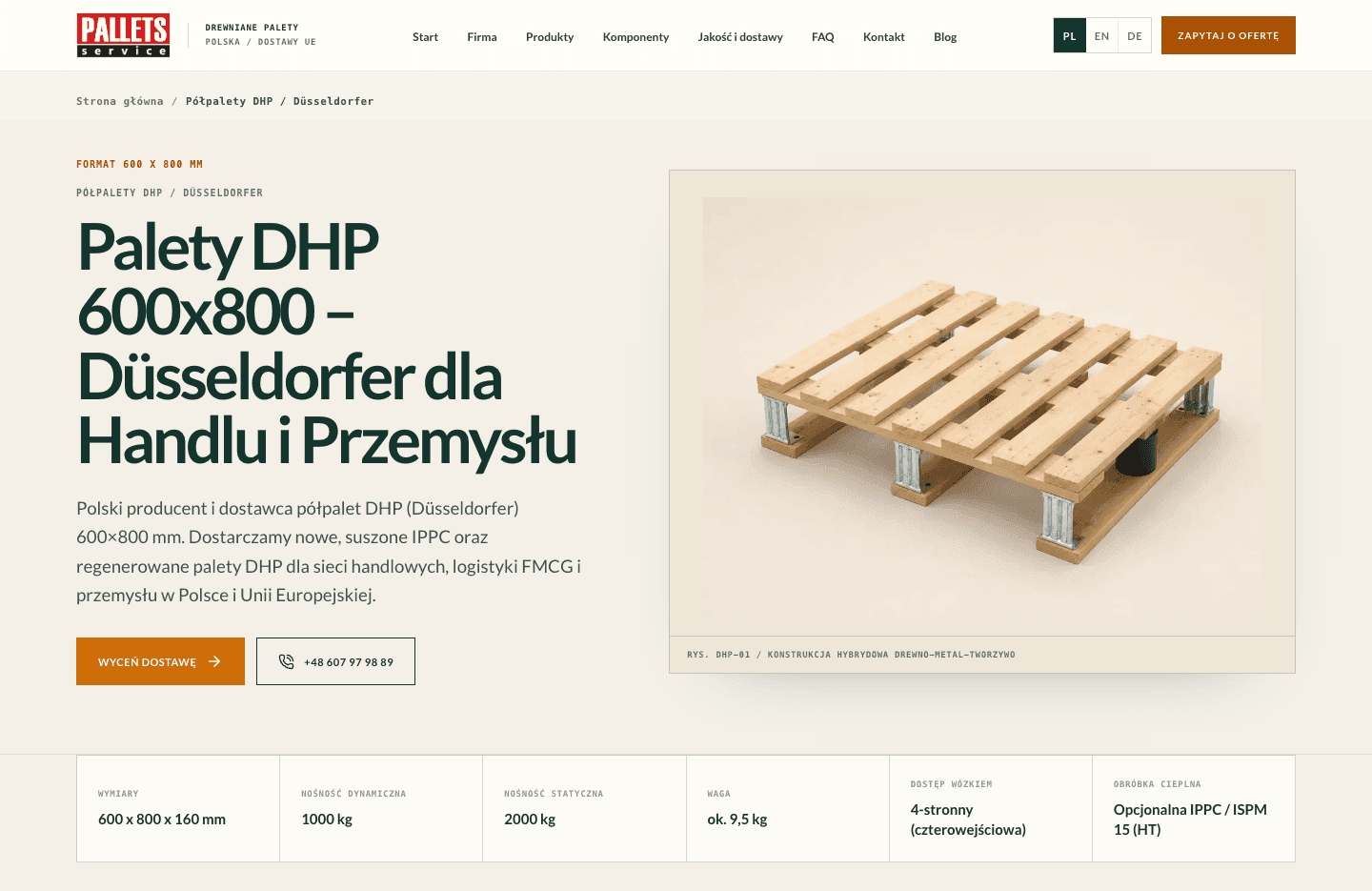
The new DHP half-pallet product page: a large heading, an image of the pallet with a technical figure caption, and a row of specifications such as dimensions, load capacity and weight
The DHP product page on the new site, with a quote button and a row of specifications.

Problem

Problem statement

The old website (© 2016) still listed the company's pallets, but it had stopped working as a sales tool. Its jQuery library was loaded over plain HTTP, so browsers blocked it, and with it the Bootstrap scripts. On a phone, the menu button did nothing. There was no inquiry form. Every page shared the same title and a two-word description, links were marked nofollow, and there was no sitemap or structured data. The English and German pages even declared themselves Polish. The homepage downloaded about 3 MB on first visit, most of it an autoplaying video. The goal was a site that loads fast on a phone, turns visits into structured quote requests and can be found in all three of the company's markets.

The previous PALLETS SERVICE home page: a red navigation bar and a video of a pallet being assembled, shown inside a computer mockup

Goals

What the site had to do

  • Make the quote request the main action, with a structured form (pallet type, quantity, delivery place, date, contact) and a CTA in the header, hero and on every product card.

  • Give each product family its own indexable page with real specs: dimensions, load capacity, variants and construction.

  • Serve Polish, English and German buyers with fully translated pages, localized URLs and hreflang.

  • Fix technical SEO: unique titles and descriptions, canonical URLs, a sitemap, and JSON-LD for the business, products, FAQs and articles.

  • Load fast on mobile. That meant no autoplay video, first-party assets only and a small JavaScript budget.

  • Make the offer readable for AI assistants: llms.txt, an MCP manifest and a WebMCP quote tool.

Way of work

My process

  1. Step 01

    Definition

    Took stock of the old site's offer (DHP, EURO/EPAL, one-way pallets, DHP parts) and its technical problems: blocked scripts, missing metadata, a nofollow robots tag and no inquiry form.

  2. Step 02

    Plan

    A one-page home (company, products, components, quality and delivery, FAQ, contact), four product pages, contact, blog and legal pages, repeated in three locales with localized slugs such as /palety-euro-epal, /en/euro-epal-pallets and /de/euro-epal-paletten.

  3. Step 03

    Design

    An industrial 'technical sheet' look: cream paper background, deep forest green and amber CTAs, Lato with JetBrains Mono labels and Roboto Slab, line drawings with figure captions and spec grids, keeping the company's red logo.

  4. Step 04

    Develop

    Astro static pages with three React islands hydrated on visibility (product carousel with a pause control, quote form, FAQ) and Tailwind CSS v4. A native details/summary mobile menu that works without JavaScript. The quote form submits to Google Forms with a honeypot field. Fonts are self-hosted and the map embed loads lazily.

  5. Step 05

    Deployment

    Vercel with immutable caching for hashed assets. A sitemap index with hreflang and image entries, robots.txt, JSON-LD on every page type, llms.txt, /.well-known/mcp.json and a web app manifest.

Technologies used

Tech stack

  • Astro
  • React
  • Tailwind CSS
  • Vercel
  • Google Forms
  • Google Maps
  • Lucide
  • WebMCP

Results

What improved

Lab measurements, 21 Nov 2026 · cold cache · same harness for both sites · not Lighthouse, not field data

  • −86%

    Homepage transfer on desktop

    3022 KB → 419 KB (−88% on mobile)

  • 2.7×

    Faster LCP, throttled mobile

    about 3.9 s → about 1.4 s

  • 0

    Console errors and third-party hosts

    down from 5 and 5

The old pallets-service.pl home page compared with the new site
MeasureBeforeAfter
Performance and health (lab)
Homepage transfer, first visit (desktop / mobile)3022 / 2866 KB419 / 355 KB
Requests (desktop / mobile)27–29 / 2818 / 17
LCP, throttled mobile profile3.84–3.94 s1.36–1.47 s
Console errors on load5 (2 blocked scripts, 3 exceptions)0
Third-party hosts on load50
Site and SEO (observed)
Mobile menuDoes not openWorks, no JavaScript needed
Inquiry formNoneStructured quote form
Page titles and descriptions1 shared title, 15-character descriptionUnique per page, 114–179 characters
robots metaindex, nofollowindex, follow
Sitemap40499 URLs with hreflang
Canonical URLsNoneOn every page
Structured data (JSON-LD)None5+ schema types
Open Graph and Twitter cardNoneYes
Languages declared correctlyNo: EN/DE pages say pl-PLYes: pl / en / de + hreflang

Static HTML, three islands

Astro renders every page to static HTML. Only three parts are interactive: the product carousel, the quote form and the FAQ. Each is a React island hydrated when it scrolls into view, so the first load transfers about 71 KB of JavaScript. The mobile menu is a native details/summary element and needs none. Fonts are self-hosted and the map loads lazily, so every request on load goes to the site's own origin.

How this was measured

Lab measurements taken on 21 Nov 2026 with headless Chrome driven over the DevTools protocol: a fresh profile for every run (cold cache), the same harness and settings for both sites, two runs per profile. Desktop 1440×900; mobile 390×844; the throttled mobile profile adds 150 ms latency, about 1.44 Mb/s download and a 4× CPU slowdown. These are not Lighthouse scores and not field data. The old homepage's Google Maps iframe is not counted, so its totals are lower bounds. The new site was measured on its vercel.app preview (CDN edge cache), the old one on its own host.

Retrospective

Challenges & learnings

Challenges

  • Three languages done properly: 24 pages and 72 articles across PL/EN/DE, each locale with its own slugs, lang attribute, hreflang alternates, OG locale and translated structured data.
  • A real quote form without a custom backend. Fields map to Google Forms entry IDs, the date is split into the year/month/day fields Google expects, submission goes through a hidden iframe so the visitor stays on the page, and a honeypot field filters bots.
  • Interactivity without a heavy bundle. The carousel, form and FAQ hydrate only when visible, so the first load ships about 71 KB of JavaScript, and the mobile menu needs none.
  • Making a niche B2B offer understandable. DHP construction counts, load capacities, IPPC variants and export rules had to be presented as scannable specs and FAQs rather than marketing copy.

Learnings

  • One hard-coded http:// script URL was enough to break the old site's whole mobile navigation. Mixed content fails silently for the owner and loudly for users.
  • The biggest single performance win was dropping the autoplay hero video. At about 2.3 MB it was most of the old homepage's weight; a single WebP hero image does the same job.

Projects

Other case studies

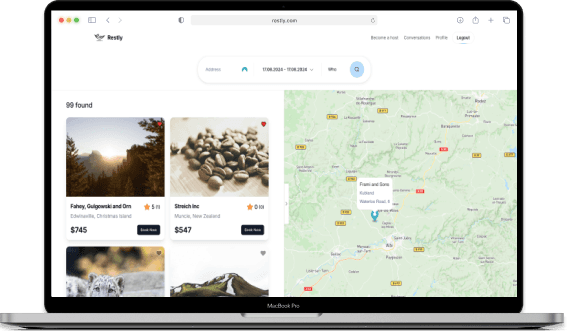
Restly

A stay booking app with maps, listings, and secure payments.

A vacation rental platform connecting hosts and guests, with map search, booking calendars, messaging and Stripe payments.

  • Next.js
  • Tailwind CSS
  • Prisma
  • MongoDB
Restly on a desktop screen
Restly on a phone

Let's work together

Have a project that needs to feel fast?

Websites, web apps, performance audits and AI automations. Tell me what you are building and I will reply with the next practical step.